Originally published June 27, 2022. Updated May 20th, 2026 with expanded guidance on mattress support, sleep position, mattress construction, and adjustable bases.
Please note: While there are many benefits to a high-quality, supportive mattress, you should not expect it to solve a chronic health issue. Please consult your doctor.
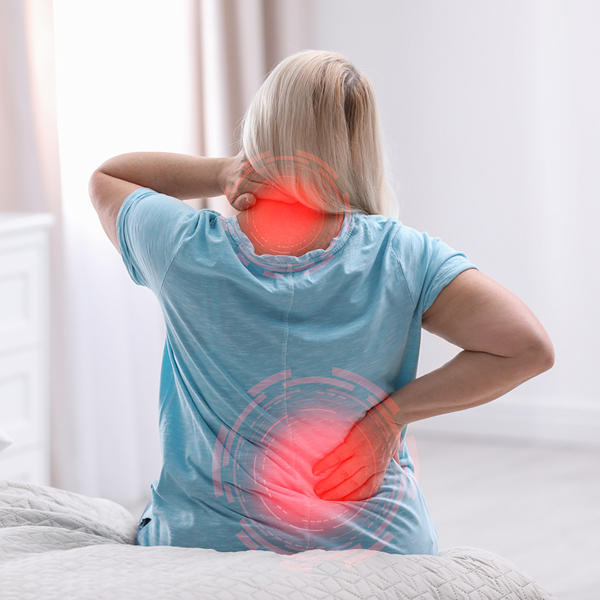
If you woke up this morning with a stiff lower back, you're not alone. It’s one of the most common complaints we hear from customers who walk through our doors. It’s also not coincidentally one of the most popular searches on the internet. Month after month, people type some version of “best mattress for back pain” into Google more than almost any other mattress-related question. All this begs the question: Can a new mattress help with my back pain?
Here’s our honest answer: we’re mattress makers, not doctors. We’re not going to tell you that buying one of our mattresses will cure your back pain. If you’re dealing with a serious or chronic condition, please talk to your physician or a physical therapist. They’re the right people for that conversation.
What we can talk about is what happens when you spend a third of your life on a surface that either works with your body or against it. And we can tell you, after more than three decades of building mattresses by hand, that the mattress underneath you matters.
In short: The best mattress for back pain is not always the firmest mattress. It is usually the mattress that gives your body the right combination of support, comfort, pressure relief, and long-term durability based on how you sleep.
Can a Mattress Help With Back Pain?
A mattress is not a prescription. It is not a cure. But the wrong sleep surface can work against your body, while a supportive one can create a better environment for rest.
Proper support is vital to healthy sleep and is especially important to spine health. While we do not make specific product recommendations, we believe everyone can benefit from high-quality support. A mattress’ support comes from its core — typically an innerspring or foam core.
What’s interesting is that this isn’t just theory. Research has shown that the surface you sleep on plays a measurable role in both comfort and back pain. In one clinical study, participants sleeping on more supportive mattresses reported less pain and better sleep quality than those on less supportive surfaces. You can read more about that research here.
What most people are really looking for is support with comfort. A surface that holds the spine in a neutral, natural position while still cushioning the body’s pressure points. That balance looks different for different people, which is why testing a mattress in person still matters more than any online algorithm. Everyone perceives comfort differently, which is why The Original Mattress Factory offers an array of products. A little trial and error, and you’ll quickly narrow down what feels right to you.
Support Is Not the Same as Comfort
This distinction is one of the most important things we talk to customers about, and it often surprises them.
Comfort is what you feel and is based on your personal preference; the softness or hardness of the various padding layers, the initial “give” when you lie down.
Support is what the mattress does over the course of the entire night. It is how well the internal structure maintains proper spinal alignment and prevents your body from sinking out of position.
You can have a mattress that feels soft or hard on the surface while still having excellent underlying support. In fact, that’s the goal. The problem arises when a mattress offers only surface comfort with no structural integrity, which, unfortunately, is more common than it should be in today’s market.
At The Original Mattress Factory, every mattress we build is designed from the inside out. The support system that keeps you properly aligned night after night is engineered first. The comfort layers come after. It’s the same approach that’s guided us since 1990.
All of our mattresses are able to provide adult-level support for every-night use. As you work your way through our lines — from Oasis to Ovation to Orthos — the quality of the innersprings improves, as does the support. Our Opulence line, which is our specialty foam mattress line, also features high-quality support thanks to its high-density foam cores.
While our Orthos and Opulence lines offer the highest-quality support, that doesn’t mean they’re the right fit for your unique needs. That’s why it’s really important to test out mattresses for as long as possible — it’s the only way to find out what really works for you.
Does a Firmer Mattress Always Help Back Pain?
There seems to be a notion that if your back hurts, you need a firmer mattress. That straightening things out is the path to feeling better. It’s intuitive, but it’s not always right. A mattress that’s too rigid creates pressure points, particularly at the hips and shoulders, that can leave you tossing and turning all night.
That doesn’t mean a softer mattress is necessarily the answer either. A mattress that’s too soft allows your body to sag in the middle. For back sleepers, that means the lower spine curves out of its natural alignment. For side sleepers, the hips and shoulders may sink unevenly. Either way, your muscles spend the night compensating for the lack of support rather than actually resting.
There is a myth that in order to get proper support, you have to get a hard mattress. But that’s not true. If you have a high-quality, supportive core, you can choose a mattress that feels as firm or soft as you like and still get the benefits of that support.
The Best Mattress for Back Pain Depends on How You Sleep
How you sleep has a real impact on what kind of mattress will work best for you.
| If you sleep on your... | What usually matters the most | What to watch for |
| Back | Support through the lumbar region, with enough cushion at the tailbone and shoulders | Too much sink in the lower back |
| Side | Enough cushion for the shoulder and hip while keeping the spine straight | Too much pressure on the shoulder or uneven sinking at the hip |
| Stomach | A harder feeling surface that helps keep the midsection from sinking | A soft mattress that arches the lower back overnight |
| Multiple positions | Solid internal support with comfort layers that work across positions | A mattress designed around only one sleep position |
Back sleepers generally benefit from a medium to medium-hard feeling mattress. A back sleeper needs enough support to keep the lumbar region from sinking, with enough cushion to avoid pressure at the tailbone and shoulders.
Side sleepers need a surface that allows the shoulder and hip to sink in slightly while keeping the spine straight. A mattress that’s too hard will push back against those pressure points; too soft, and the hip drops and the spine curves.
Stomach sleepers typically need a harder feeling surface. When the midsection sinks into a soft mattress, it forces the lower back into an arched position all night — something most people feel the next morning.
And many of us move through multiple positions during the night. That’s one more reason why a well-built mattress with solid internal support and padding tailored to your personal comfort tends to serve combination sleepers better than one engineered for a single position.
Again, everyone perceives comfort differently. While one side sleeper may prefer a softer feel, another may prefer something harder. We may sound like a broken record about the importance of trying them out for yourself, but your sleep, and ultimately your health, benefit from taking the time to make the right decision.
What to Look for in a Mattress if You Wake Up With Back Pain
If you’re shopping for a mattress and back pain is part of the reason, it helps to separate the different things your body may need from the mattress.
| What to look for | Why it matters |
| High-quality support | Helps keep your body from sinking out of position overnight |
| Comfortable surface feel | Helps reduce pressure and makes it easier to relax |
| Pressure relief | Especially important around the hips, shoulders, and lower back |
| Durable construction | Helps the mattress maintain support over time |
| The right fit for your sleep position | Different positions place pressure on different parts of the body |
If your current mattress has seen better days, it may be worth evaluating whether it’s still providing the support it once did. Body impressions, sagging edges, or consistently waking up stiffer than when you went to bed are all worth paying attention to.
Why Mattress Construction Matters Over Time
Most mattresses sold today are one-sided. You can’t flip them. That means all the wear and compression happens on a single sleep surface. Over time, body impressions form, support diminishes, and what was once a supportive mattress begins to work against you.
We still build two-sided mattresses. You can flip them regularly, typically every 3 to 6 months, extending the mattress’s life and helping maintain consistent support over time. Both sides are fully upholstered and fully functional.
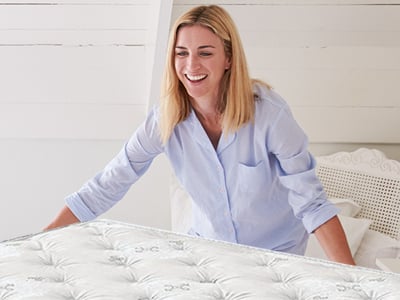 It costs more to build a mattress this way. That’s why most of the industry stopped doing it. But when people ask us why their old mattress seemed to “give out” before its time, this is usually a big part of the answer.
There’s also research to support what we see every day. Studies have shown that as mattresses age and lose their structural support, sleep quality declines and discomfort, including back pain, can increase. Maintaining consistent support over time isn’t just about durability, it’s about continuing to give your body the proper alignment it needs night after night.
All things being equal, a two-sided mattress should last longer. Two sides to use, two sides to sleep on, and more consistent support over the life of the mattress.
When Your Mattress May Be Part of the Problem
Not every ache or pain starts with your mattress. But there are some signs that your mattress may no longer be giving your body the support it once did.
Your mattress may be worth reevaluating if:
-
You regularly wake up stiffer than when you went to bed.
-
You notice visible body impressions or sagging.
-
The edges no longer feel supportive.
-
You toss and turn because of pressure at your hips, shoulders, or lower back.
-
The mattress used to feel comfortable, but no longer does.
If those issues sound familiar, the problem may not simply be how firm or soft the mattress feels. It may be that the mattress is no longer keeping your body properly supported through the night.
Which Original Mattress Factory Options Should You Try?
Our Orthos and Opulence lines offer the highest-quality support — not just out of the lines we offer at Original Mattress Factory, but also of most mattresses available on the market today. If you’re looking for proper support, these lines can provide great options to try.
Our Orthopedic line features eight models that range from very firm to very soft. They are all two sided, so they can be flipped and rotated regularly to improve long-term comfort and durability. Our Orthos innerspring features a six-turn, 12.75-gauge, knotted offset coil and a 6-gauge border rod for edge-to-edge support. This innerspring is manufactured exclusively for The Original Mattress Factory.
Our Opulence line features three all-foam models. The Opulence and Opulence Plush are memory foam, while the Opulence Latex is a two-sided latex foam model. The Opulence line’s 2.25 lb/ft³ density foam cores vary by model, but each offers excellent support. The core is 6 inches thick in the Opulence, 4.5 inches thick in the Opulence Latex, and 3 inches thick in the Opulence Plush.
Again, while these lines offer high-quality support, that doesn’t mean one of them is automatically the right mattress for every person with back pain. The right choice still depends on your body, your comfort preferences, and how you sleep.
Should You Consider an Adjustable Base for Back Pain?
When you’re dealing with back pain, you may want to consider an adjustable base when you’re shopping for a new mattress. The ability to raise the head and foot of your mattress to your desired height may take some pressure off of your back. Adjustable bases can make sleeping, reading, and watching TV in bed even more comfortable.
We offer two high-quality adjustable bases: the Style and Style Plus. These bases pair perfectly with nine different mattress options, including the entire Opulence line and three Orthopedic models.
How to Test a Mattress if You Have Back Pain
If you’re shopping for a new mattress, we’d offer this simple advice: don’t base your decision on a picture, a review, or a price tag alone. Come in. Lie down. Spend time on the mattress in your actual sleep position, not just a quick two-minute test on your back.
The only way to find the right mattress for you is to test them out in person for as long as possible — and that’s especially important if you’re dealing with back pain or other chronic pain issues. We recommend spending at least 15 minutes in your natural sleeping position before making your selection — and preferably longer if you’re dealing with back pain or other chronic pain issues.
Our other tips include:
-
Focus on high-quality support.
-
Then find the comfort level that works for you.
-
Consider an adjustable base or other sleep accessories like body pillows to add additional relief.
Almost every week, new research continues to reinforce just how important sleep and the surface you sleep on really is. At The Original Mattress Factory, we’ll give you all the time and space you need to make the choice that’s right for you.
A mattress is a long-term investment in the quality of your rest. It’s not a prescription. It’s not a cure. But the right one, built well and maintained properly, gives your body the best possible environment to do what it naturally needs to do every night.
And that’s worth getting right.
Ready to start your mattress buying journey? Come to The Original Mattress Factory first. No one knows more than our team about what makes a great mattress great. Whether you buy from us or not, you’ll be better prepared to make a smart mattress buying decision.

Written By: Chris Gardner, OMF Marketing
Frequently Asked Questions Related to Mattresses and Back Pain
Before choosing a mattress, it helps to understand how support, comfort, sleep position, and mattress construction all work together. Below, we’ve answered some of the most common questions customers ask us when they’re shopping for a mattress and dealing with back pain or stiffness.
Is a firm mattress always better for back pain?
No. A firmer mattress is not automatically better. The better choice is a mattress that provides strong support while still offering enough comfort and pressure relief for your body and sleep position.
What mattress type is best for lower back pain?
There is no single best mattress type for everyone. Innerspring and foam mattresses can both provide good support when they are built with a high-quality support core and matched to the sleeper’s comfort needs.
How long should I test a mattress in-store if I have back pain?
Spend at least 15 minutes in your natural sleeping position, and longer if possible. A quick test on your back may not tell you how the mattress will feel through the night.
Can an adjustable base help with back pain?
An adjustable base may help some people feel more comfortable by allowing them to raise the head or foot of the mattress. It is not a cure, but it can be worth considering along with the right mattress.